The Paradox of Elections without Alternation in Sub-Saharan Africa: How Institutional Capture Constrains Electoral Alternation
Moise Tchankoumi
Secretary-General of the
Observatory of Political Transition and Conflicts in Africa (OPTCA)
a retired university professor, political scientist, and economist
Paris – France
0rchid.https://orcid.org/0009-0003-6908-9242
Abstract
Since 1990, Sub-Saharan Africa has held more than 200 presidential elections. Yet, fewer than one in eight have produced alternation — a pattern that persisted in 2024–2025, when only a single contest among more than a dozen resulted in a change of leadership.
Why do multiparty elections so rarely lead to turnover? This article introduces the concept of Regimes of Systemic Institutional Capture (RSIC), in which electoral commissions, courts, media, and other institutions become systematically aligned to sustain incumbents. Using a new index covering 24 countries (1990–2024), we show that above a critical threshold (IS‑RSIC ≈ 0.75–0.80), alternation becomes extremely unlikely, whereas below this threshold, elections retain their capacity to produce change.
A structured comparison of Ghana and Cameroon illustrates how differing degrees of institutional coordination shape divergent trajectories of electoral alternation. The article concludes that neither electoral reform nor popular mobilization alone is sufficient where institutional capture has become systemic; political opening depends on broader changes in institutional configurations.
Keywords: Authoritarianism; Electoral alternation; Authoritarian resilience; Hybrid regimes; Political institutions; Democratic erosion; Sub-Saharan Africa; RSIC.
Introduction
Since the early 1990s, multiparty elections have become a routine feature of political life across Sub-Saharan Africa. New constitutions were adopted, opposition parties legalized, and electoral commissions established. Yet this institutional transformation has produced a striking paradox: despite more than two hundred presidential elections held since 1990, electoral alternation remains exceptionally rare. In most countries, incumbents continue to win by large margins, often for decades, even as elections are regularly organized and formally competitive. This disjuncture between democratic procedures and democratic outcomes (Cheeseman 2010, 93–94; Posner & Young 2007, 126) raises a central question for African politics: why do elections so seldom produce turnover?
Scholars have offered a range of explanations. Research on electoral malpractice highlights fraud, intimidation, and administrative manipulation (Schedler 2002; Lehoucq 2003). Neopatrimonial approaches emphasize patronage, clientelism, and personalized rule (Bratton & van de Walle 1997; Bleck & van de Walle 2019). Studies of competitive authoritarianism show how incumbents tilt the playing field while maintaining democratic façades (Levitsky & Way 2010; LeBas 2016). These perspectives have generated important insights, yet they often examine individual mechanisms in isolation. As a result, they struggle to explain why some countries—such as Ghana, Senegal, or Benin—have experienced repeated alternation, while others—such as Cameroon, Uganda, or Congo‑Brazzaville—have held multiparty elections for more than three decades without a single transfer of executive power.
This article advances a different argument. It introduces the concept of Regimes of Systemic Institutional Capture (RSIC) to describe political systems in which multiple formally autonomous institutions—electoral commissions, courts, legislatures, media systems, civil society, and security forces—become functionally aligned in ways that systematically reduce the uncertainty of electoral competition. The argument is not simply that incumbents manipulate elections, but that institutional coordination across domains transforms elections into instruments of political continuity. RSIC thus captures a configuration in which institutions retain their formal pluralism yet operate collectively to reproduce incumbency.
A second contribution is to show that institutional capture operates non‑linearly. At low or moderate levels, competition remains uncertain, and alternation is possible. Beyond a critical threshold, however, institutional coordination reaches a point of systemic saturation, after which alternation becomes structurally improbable despite the continued organization of elections. Drawing on an original index of institutional capture (IS‑RSIC) covering 24 countries and 187 electoral cycles between 1990 and 2024, this article demonstrates that alternation becomes exceedingly rare once countries cross a threshold of approximately 0.75–0.80 on the IS‑RSIC scale—a tipping point that existing linear models do not predict.
The article proceeds in four steps. Section 2 situates the RSIC framework within existing debates on electoral authoritarianism, neopatrimonialism, and hybrid regimes. Section 3 introduces the IS‑RSIC index and explains how it captures cross‑domain institutional coordination. Section 4 presents empirical evidence of a strong, non‑linear association between institutional capture and the probability of alternation. Section 5 illustrates the causal mechanism through a structured comparison of Ghana and Cameroon. A final section discusses implications for democracy promotion.
By foregrounding the systemic rather than fragmented nature of incumbency advantage, this article contributes to broader debates in African Studies on authoritarian resilience, democratic erosion, and the institutional foundations of political continuity. It argues that where institutional capture has become systemic, neither electoral reform nor popular mobilization alone is sufficient to produce alternation; meaningful political opening depends on broader transformations in the institutional architecture of competition.
Why Existing Explanations Fall Short
Why do some African countries hold multiparty elections for decades without ever experiencing alternation, while others alternate regularly? Scholars have proposed three main families of explanation, each capturing important mechanisms but each remaining incomplete.
Electoral manipulation and fraud. A first line of research emphasizes ballot stuffing, intimidation, and result tampering (Schedler 2002; Lehoucq 2003). While such practices certainly shape outcomes, this perspective remains event‑centered. It explains how incumbents cheat but not why cheating succeeds in some contexts and fails in others. Moreover, similar levels of manipulation often produce different outcomes: Ghana’s 2012 election was disputed but resolved through courts, leading to eventual alternation; Cameroon’s elections have faced similar allegations without any turnover.
Neopatrimonialism and clientelism. A second approach highlights patronage, personalized authority, and the distribution of state resources to secure loyalty (Bratton & van de Walle 1997; Bleck & van de Walle 2019). Yet clientelistic practices are widespread even in countries that experience regular alternation—Senegal under the Sopi coalition, for example, or Ghana under both NDC and NPP. Clientelism alone, therefore, cannot explain the difference between competitive and locked regimes.
Competitive authoritarianism. A third framework shows how formally democratic institutions coexist with systematically uneven competition (Levitsky & Way 2010; LeBas 2016). This is valuable, but it treats incumbency advantage as a matter of degree. It does not tell us when competition shifts from uneven but meaningful to structurally closed. In Levitsky and Way’s original formulation, competitive authoritarian regimes still leave room for opposition victories. Yet in countries such as Cameroon or Rwanda, no alternation has occurred in more than three decades despite regular elections. Something beyond “uneven competition” is at work.
What these approaches miss. Taken together, these perspectives converge on a key insight: incumbents benefit from multiple and overlapping sources of advantage. Yet they usually analyze these mechanisms separately. As a result, they struggle to explain why electoral competition remains open to alternation in some contexts while becoming predictably inert in others. What is missing is an understanding of how electoral, judicial, media, legislative, and coercive institutions interact and reinforce one another to produce systemic closure. The next section develops the concept of Regimes of Systemic Institutional Capture (RSIC) to fill this gap.
Regimes of Systemic Institutional Capture (RSIC)
This section develops the concept of Regimes of Systemic Institutional Capture (RSIC) as a framework for understanding why elections in some African countries generate meaningful uncertainty while in others they do not. It first defines RSIC and its scope conditions, then specifies the mechanism of progressive institutional coordination, and finally distinguishes RSIC from existing frameworks.
Definition and Scope Conditions
A Regime of Systemic Institutional Capture (RSIC) is a political system in which multiple formally autonomous institutional arenas—electoral commissions, courts, legislatures, media systems, civil society, and security forces—become functionally aligned to systematically reduce the probability of incumbent defeat.
Three scope conditions distinguish RSIC from other regime types.
First, formal institutional pluralism must exist. RSICs are not closed authoritarian systems. They maintain the institutional architecture of electoral democracy: multiparty competition, regular elections, and constitutional guarantees.
Second, cross-domain coordination must be present. Institutional capture is not limited to a single arena (elections or media, for example). It extends across multiple domains that reinforce one another.
Third, outcome regularity must be observable. Elections occur repeatedly without producing alternation—not as an isolated event but as a stable pattern over time.
Only when these three conditions are jointly satisfied can a regime be classified as an RSIC.
Mechanism: From Fragmented Advantage to Systemic Closure
The core mechanism behind RSIC is the shift from fragmented incumbency advantages to systemic institutional closure.
In many hybrid regimes, incumbents control specific arenas—state resources, media outlets, or parts of the electoral administration. This tilts competition without eliminating uncertainty. Opposition actors can still exploit inconsistencies, such as relatively independent courts or divided elites.
In RSIC contexts, however, these arenas become functionally synchronized. Electoral commissions shape eligibility. Courts validate outcomes. Media structure public narratives. Legislatures regulate competition. Security forces manage dissent. What matters is not the strength of any single tool, but their mutual reinforcement.
The result is a transformed structure of competition. Instead of navigating partially independent institutions, opposition actors confront an integrated system. Openings in one domain are neutralized by constraints in others. Participation remains possible, but meaningful alternation becomes structurally improbable.
This process unfolds gradually. Institutional reforms, legal adjustments, and administrative changes accumulate over time, producing a political environment of institutional saturation—where constraints in one domain are systematically reinforced by constraints in others.
RSIC in Comparative Perspective
RSIC does not replace existing frameworks on hybrid regimes. It refines them by identifying a specific configuration of power: the systemic coordination of formally autonomous institutions to secure incumbency.
- Electoral authoritarianism explains how elections persist through fraud, intimidation, and administrative bias. RSIC extends this view by shifting attention from isolated manipulation to the broader institutional environment within which elections are embedded.
- Neopatrimonial approaches emphasize patronage and personalized authority. RSIC instead foregrounds the strategic alignment of formal institutions as a central source of regime durability.
- Competitive authoritarianism (Levitsky & Way 2010) is its closest relative. Both highlight uneven competition. But RSIC introduces a qualitative distinction: beyond a critical threshold of institutional coordination, competition becomes structurally closed. Uncertainty is not merely reduced—it is systematically contained.
This distinction matters. In regimes with fragmented incumbency advantages, institutional inconsistencies may still create openings for opposition actors. In RSIC configurations, constraints reinforce one another, producing strategic closure. Participation remains possible, but alternation becomes structurally improbable.
RSIC should therefore be understood as a framework centered on the degree of institutional coordination, not merely the presence of elections. This raises an empirical challenge: how do we measure systemic coordination across countries and over time? The next section addresses this by introducing the Institutional Capture Index (IS‑RSIC).
Measuring Institutional Capture: The IS‑RSIC Index
To evaluate the RSIC framework empirically, this article introduces the Institutional Capture Index (IS‑RSIC) – a composite measure designed to capture the extent to which political institutions become aligned with incumbent reproduction. Rather than relying on a single indicator (such as electoral fraud or media freedom alone), the index aggregates multiple institutional arenas to capture systemic coordination.
What the Index Measures
The IS‑RSIC index is built on eight dimensions of institutional capture, each representing a different arena in which incumbents may seek to control or coordinate outcomes. These dimensions were selected because they correspond to the principal institutional sites where political competition is structured in practice: electoral management, judicial independence, media autonomy, legislative oversight, civil society space, elite cohesion, coercive capacity, and strategic adaptation.
Table 1 – Eight dimensions of institutional capture (IS‑RSIC)
| Dimension | What it captures |
| Electoral Capture (EC) | Whether elections generate meaningful uncertainty |
| Judicial Capture (JC) | Executive influence over courts |
| Media Capture (MC) | Constraints on media autonomy and pluralism |
| Legislative Capture (LC) | Subordination of parliament to executive authority |
| Civil Society Capture (CSC) | Regulation and repression of civic actors |
| Elite Cohesion (ECO) | Unity and coordination within ruling elites |
| Coercive Capacity (CC) | Ability to deploy repression effectively |
| Strategic Adaptation Capacity (SAC) | Capacity to adjust institutions to maintain power |
Taken together, these eight dimensions capture not just whether incumbents control individual institutions, but whether those controls work together systematically.
Data Sources and Construction
The index draws on multiple established datasets to reduce single‑source bias: Varieties of Democracy (V‑Dem), Freedom House, Afrobarometer, the World Justice Project, and ACLED. Each dimension is constructed from two to three indicators, aggregated, and then rescaled to a final 0–1 index where higher scores mean greater institutional capture. Equal weighting is applied to avoid imposing arbitrary assumptions about the relative importance of each dimension. While the index is not a perfect measure – data quality varies across countries and over time – it provides a transparent and replicable tool for comparing institutional capture across 24 countries from 1990 to 2024.
“For the sake of conciseness, detailed technical information on index construction—including normalization procedures, dimension aggregation, and robustness checks—is omitted here but is available from the corresponding author upon request.”
Two Illustrative Cases: Ghana and Cameroon
To make the index concrete, Table 2 shows dimension scores and final IS‑RSIC values for Ghana and Cameroon – our two comparison cases.
Table 2 – IS‑RSIC scores: Ghana vs Cameroon
| Country | EC | JC | MC | LC | CSC | ECO | CC | SAC | IS‑RSIC |
| Ghana | 1.35 | 1.30 | 1.50 | 1.35 | 1.60 | 1.75 | 1.75 | 1.55 | 0.44 |
| Cameroon | 3.60 | 3.50 | 3.60 | 3.55 | 3.60 | 3.55 | 3.75 | 3.65 | 0.92 |
| Note: Scores range 0–4 per dimension; IS‑RSIC ranges 0–1. Higher scores = greater capture. |
The contrast is stark. Ghana scores 0.44 – well below the critical threshold identified in the next section. Cameroon scores 0.92 – near the theoretical maximum. This difference in institutional coordination helps explain why Ghana alternates power regularly while Cameroon does not. The next section reports the full empirical findings.
Empirical Findings: Capture and the Threshold Effect
Does institutional capture actually predict the absence of electoral alternation? This section reports the empirical findings. The analysis covers 187 electoral cycles across 24 Sub-Saharan African countries between 1990 and 2024.
The Main Finding: Higher Capture, Lower Alternation
The results strongly support the central hypothesis. Higher institutional capture is systematically associated with a lower probability of electoral alternation. Countries with low IS‑RSIC scores—such as Ghana (0.44), Senegal (0.48), or Benin (0.55)—display alternation rates consistent with competitive electoral politics. By contrast, countries with high capture—such as Cameroon (0.92), Uganda (0.91), or Rwanda (0.97)—exhibit near‑zero alternation despite holding regular elections.
Substantive Effects: From Probability to Structural Improbability
To understand the magnitude of this relationship, Table 3 reports predicted probabilities of alternation across different levels of institutional capture.
Table 3 – Predicted probability of alternation
| IS‑RSIC Level | Predicted Probability |
| 0.40 | 58% |
| 0.60 | 30% |
| 0.75 | 12% |
| 0.85 | 5% |
| 0.95 | 1% |
The decline is steep. At low capture levels (0.40), alternation is more likely than not. At moderate capture (0.60), the probability falls to 30%. At the threshold region (0.75), it drops to 12%. Above 0.85, alternation becomes highly improbable – below 5%. At 0.95, it is essentially zero.
The Threshold Effect: Evidence of Structural Closure
The relationship is not linear. Below approximately 0.75, elections retain meaningful uncertainty. Above this threshold, alternation becomes extremely rare. A striking empirical fact: in the entire sample of 187 electoral cycles, no alternation occurred above an IS‑RSIC score of 0.85. Elections continue to occur. Opposition parties participate. But incumbents do not lose.
Figure 1 illustrates this non‑linear pattern. The solid curve shows predicted probabilities across IS‑RSIC levels. The dashed vertical line marks the estimated threshold at 0.75.
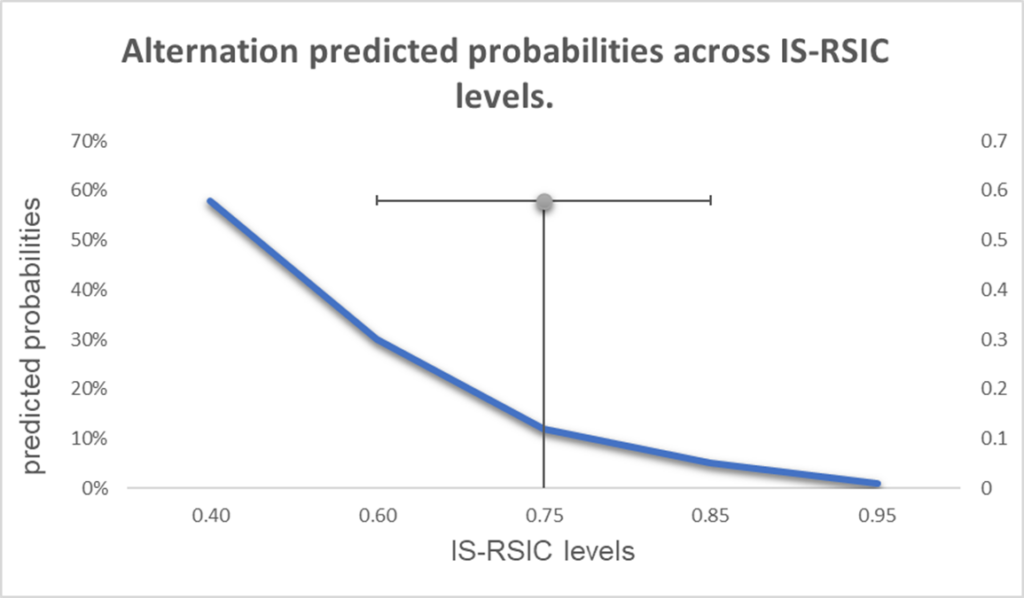
Below the threshold, the curve slopes downward gradually. Above the threshold, it flattens near zero. This is not a gradual continuum. It is a tipping point.
What the Threshold Means
Below approximately 0.75, elections retain some uncertainty. Opposition actors can still win – as in Ghana (2000, 2008, 2016), Senegal (2000, 2012, 2024), or Benin (1996, 2006, 2016).
Above approximately 0.80, however, the structure of competition changes qualitatively. Constraints in one domain are reinforced by constraints in others. Electoral commissions shape eligibility. Courts validate outcomes. Media limit opposition visibility. Security forces raise the cost of dissent. Opposition actors face not isolated obstacles but an integrated system.
This is what we mean by structural closure. Elections persist, but they no longer function as mechanisms for selecting leaders. They become instruments of controlled predictability – legitimizing incumbents without producing turnover.
Prospective Application: Forecasting Alternation Risk
The RSIC framework also enables forward‑looking analysis. Table 4 reports projected probabilities for upcoming elections (2025–2029). These are probabilistic forecasts, not certain predictions. Shocks – economic crises, elite ruptures, mass protests, or coups – can alter trajectories independently of institutional capture.
Table 4 – Forecasted probability of alternation in upcoming elections
| Country | Election Year | IS‑RSIC | Predicted Probability | Regime Category |
| Ghana | 2028 | 0.46 | 61% | Competitive |
| Senegal | 2029 | 0.48 | 57% | Competitive |
| Benin | 2026 | 0.55 | 41% | Hybrid |
| Nigeria | 2027 | 0.58 | 34% | Hybrid |
| Kenya | 2027 | 0.61 | 29% | Hybrid |
| Tanzania | 2030 | 0.73 | 14% | High‑capture |
| Angola | 2027 | 0.79 | 8% | High‑capture |
| Togo | 2025 | 0.84 | 4% | Locked |
| Uganda | 2026 | 0.91 | 1% | Locked |
| Cameroon | 2025 | 0.93 | 1% | Locked |
| Rwanda | 2029 | 0.97 | ~0% | Locked |
The results reveal a clear stratification: low‑capture regimes (<0.60) retain high alternation probabilities; intermediate regimes (0.60–0.75) show heavily reduced probabilities; high‑capture locked regimes (>0.80) exhibit structural closure, with alternation effectively impossible despite continued elections.
What the Analysis Establishes – And What It Does Not
What we can claim. Four findings are robust: (1) a strong non‑linear association between institutional capture and alternation; (2) a threshold pattern (approximately 0.75–0.80) beyond which alternation becomes extremely rare; (3) robustness across alternative specifications; and (4) mechanistic plausibility, illustrated by the Ghana‑Cameroon comparison.
What we cannot claim. No definitive causal effect – prolonged incumbency may enable capture, just as capture prevents alternation. The relationship is almost certainly mutually reinforcing. The estimated threshold is also sample‑specific and requires out‑of‑sample validation.
The next section illustrates the causal logic behind this threshold effect through a detailed comparison of Ghana and Cameroon.
Causal Mechanisms in Comparative Perspective: Ghana and Cameroon
Statistical associations alone cannot explain how institutional capture operates in practice. This section complements the quantitative analysis with a structured comparison of two countries that introduced multiparty elections in the early 1990s but produced sharply different electoral trajectories: Ghana (regular alternation) and Cameroon (no alternation since 1992).
Ghana: Fragmented Institutions and Competitive Uncertainty
In Ghana, institutional reforms since the 1990s have strengthened electoral management, judicial independence, and civil society oversight. The Electoral Commission gained credibility through transparent procedures; courts asserted independence in key disputes; and civil society organizations played a central role in monitoring elections. These dynamics preserved uncertainty and enabled alternation in 2000, 2008, and 2016.
Importantly, these arenas operate with relative independence from one another. Opposition actors facing obstacles in one domain may still mobilize support or seek recourse in another. This institutional fragmentation preserves uncertainty regarding electoral outcomes.
The result is not perfect neutrality. Incumbency advantages exist, as in most democracies. But they remain limited and insufficiently synchronized to prevent alternation. Elections, therefore, continue to function as meaningful mechanisms of leadership selection.
Cameroon: Institutional Coordination and Electoral Closure
Cameroon followed a different trajectory. Institutional reforms—the creation of ELECAM, the restructuring of the Constitutional Council, and the expansion of security forces—consolidated executive dominance. Media regulation tightened, civil society space narrowed, and judicial institutions became increasingly aligned with the presidency. These changes produced a political environment in which elections occur regularly but without meaningful uncertainty.
The key feature is not a single form of manipulation but the coordination of constraints across multiple institutional domains. Electoral administration remains closely tied to executive authority; courts rarely provide effective oversight of electoral disputes; state influence over the media limits opposition visibility; legislative institutions provide minimal counterweight; civil society operates under significant restrictions; and coercive institutions raise the cost of dissent.
These mechanisms reinforce one another. Openings that might exist in one arena are neutralized by constraints in others. Participation remains formally possible, but the institutional environment substantially reduces the probability of incumbent defeat. Cameroon, therefore, operates above the RSIC threshold identified in Section 5: elections persist procedurally while competitive uncertainty becomes structurally constrained.
The Contrast in Summary
Table 5 – Ghana and Cameroon compared
| Ghana | Cameroon | |
| Multiparty elections since | 1992 | 1992 |
| Electoral alternations | 3 | 0 |
| IS‑RSIC score | 0.44 | 0.92 |
| Regime type | Competitive | Locked |
The contrast illustrates the central mechanism of the RSIC framework: the degree of coordination across institutional arenas. Ghana’s fragmented institutional landscape preserves openings for alternation, while Cameroon’s coordinated configuration produces structural closure.
Implications of the Comparison
This comparison highlights three broader points. First, similar formal institutions can produce radically different outcomes depending on how institutional arenas interact in practice. Second, institutional capture appears cumulative and self‑reinforcing: prolonged incumbency facilitates deeper coordination, which further reduces the likelihood of alternation. Third, the threshold effect identified in Section 5 reflects real institutional configurations—not abstract correlations.
The broader implication is that elections cannot be understood independently of the institutional environments in which they operate. What matters is not only whether elections occur, but whether institutional configurations preserve meaningful uncertainty regarding political outcomes.
The next section develops this implication further, examining how elections in high‑capture systems function less as mechanisms of leadership selection than as instruments of political continuity.
Elections as Instruments of Political Continuity in High‑Capture Regimes
The findings presented in this article suggest that elections in high‑capture regimes operate according to a logic distinct from that assumed in much of the democratization literature. Rather than serving as mechanisms of leadership selection, elections in these contexts function as instruments of political continuity. Their role is not merely symbolic: they structure elite bargaining, channel citizen participation, and provide periodic moments of legitimation, even as the probability of alternation approaches zero.
How Elections Change Function
When electoral commissions, courts, media systems, legislatures, and security forces become aligned around incumbency reproduction, elections retain their formal attributes but lose their capacity to generate uncertainty. Participation remains possible, but outcomes become predictable. In this sense, high‑capture regimes do not eliminate elections; they reconfigure their function.
Understanding elections in high‑capture contexts, therefore, requires shifting analytical focus from the integrity of electoral events to the broader institutional configurations that shape political competition. The RSIC framework highlights how institutional saturation transforms elections from arenas of contestation into arenas of controlled continuity.
Implications for Democracy Promotion
If this analysis is correct, then democracy promotion in high‑capture regimes faces a sobering reality: electoral reforms alone will not produce alternation where institutional capture is systemic.
Conventional democracy assistance focuses on voter registration, election observation, and technical support to electoral commissions. These interventions may improve procedural quality at the margins, but they cannot overcome coordinated constraints across judicial, media, legislative, and coercive domains.
What would a more effective approach look like? Four implications follow from the RSIC framework.
First, address the entire institutional architecture. Electoral reforms must be accompanied by parallel efforts to strengthen judicial independence, media pluralism, legislative oversight, and civil society space. Piecemeal interventions are unlikely to succeed where constraints are mutually reinforcing.
Second, use the IS‑RSIC index as an early warning tool. Rising capture scores may signal democratic erosion before alternation becomes impossible. Regional organizations such as the African Union and ECOWAS could monitor institutional capture to target preventive interventions before thresholds are crossed.
Third, recognize that elections alone are not enough. International observation missions that declare elections “free and fair” while ignoring systemic capture may unintentionally legitimate closed political orders. Election observation must be accompanied by institutional assessment.
Fourth, consider alternative pathways to political change. Where electoral alternation has become structurally improbable, other avenues deserve attention: inclusive political dialogue, regional mediation, elite bargaining, and negotiated transitions. These are not ideal solutions, but they may be realistic ones in locked regimes.
A Note on Extra‑Electoral Change
Where elections cease to provide credible prospects for turnover, opposition actors and segments of society may gradually lose confidence in electoral competition as an effective mechanism of political change. Under such conditions, the likelihood of alternative forms of succession—mass protests, elite ruptures, or military intervention—may increase. Recent coups in the Sahel suggest that the erosion of credible electoral uncertainty can generate broader crises of legitimacy. This article does not claim that institutional capture causes coups directly, but locked electoral regimes may face increasing long‑term risks of extra‑constitutional succession.
Summary
The RSIC framework reframes how we understand elections in hybrid regimes. In high‑capture contexts, elections do not function as mechanisms of uncertainty but as instruments of controlled predictability. Recognizing this is not cynicism; it is realism. And realism is the first step toward designing strategies that might actually work.
Conclusion: Elections Under Conditions of Institutional Closure
This article set out to explain why multiparty elections in Sub‑Saharan Africa so rarely produce alternation despite three decades of institutional reform and electoral routinization. The central claim is that the key to understanding this paradox lies not in isolated episodes of manipulation or clientelism, but in the broader architecture of systemic institutional coordination.
We introduced the concept of Regimes of Systemic Institutional Capture (RSIC) to describe contexts in which electoral commissions, courts, legislatures, media systems, civil society, and coercive institutions become functionally aligned to systematically reduce electoral uncertainty. The IS‑RSIC index provides a transparent and replicable tool for assessing these dynamics across countries and over time.
The empirical findings reveal a strong and non‑linear association between institutional capture and electoral alternation. Below a threshold of approximately 0.75–0.80 on the IS‑RSIC scale, elections retain meaningful uncertainty; above it, alternation becomes structurally improbable. In our sample of 187 electoral cycles, no alternation occurred above an IS‑RSIC score of 0.85. This threshold dynamic helps explain why some countries—Ghana, Senegal, Benin—experience repeated turnovers while others—Cameroon, Uganda, Rwanda—hold elections for decades without a single change in leadership.
The comparison between Ghana and Cameroon illustrated the mechanism in practice. Ghana’s fragmented institutional landscape preserves openings for alternation; Cameroon’s tightly coordinated environment produces structural closure. What matters is not the strength of any single institution, but the degree of coordination across them.
These findings have implications for democracy promotion. Electoral reforms alone cannot produce alternation in high‑capture regimes. Democratization strategies must address the entire institutional architecture—judicial independence, media pluralism, legislative oversight, and civil society autonomy—simultaneously.
Future research should examine how institutional capture evolves over time, how it interacts with elite dynamics, and how citizens navigate political systems where elections are regular but uncertainty is constrained. Understanding these dynamics is essential for interpreting the persistence of incumbency and the prospects for political change across the continent.
Final word. This article does not claim that institutional capture makes alternation impossible. Shocks—economic crises, elite ruptures, mass protests, or coups—can still alter political trajectories. But it does claim that in high‑capture regimes, elections alone are unlikely to produce change. Recognizing this is not cynicism. It is realism. And realism is the first step toward designing strategies that might actually work.
Bibliography
Bayart, J.-F. 1989. L’État en Afrique: La politique du ventre. Paris: Fayard.
Besley, T. & A. Prat. 2006. ‘Handcuffs for the grabbing hand? Media capture and government accountability’, American Economic Review 96, no. 3: 720-36.
Bleck, J. & N. van de Walle. 2019. Electoral Politics in Africa Since 1990: Continuity in Change. Cambridge: Cambridge University Press.
Bratton, M. & N. van de Walle. 1997. Democratic Experiments in Africa: Regime Transitions in Comparative Perspective. Cambridge: Cambridge University Press.
Cheeseman, N. 2010. ‘African elections as vehicles for change’, Journal of Democracy 21, no. 4: 93-107.
Diamond, L. 2002. ‘Thinking about hybrid regimes’, Journal of Democracy 13, no. 2: 21-35.
Erdmann, G. & U. Engel. 2007. ‘Neopatrimonialism reconsidered: critical review and elaboration of an elusive concept’, Commonwealth & Comparative Politics 45, no. 1: 95-119.
Gandhi, J. 2008. Political Institutions under Dictatorship. Cambridge: Cambridge University Press.
Huntington, S. P. 1991. The Third Wave: Democratization in the Late Twentieth Century. Norman, OK: University of Oklahoma Press.
LeBas, A. 2016. ‘The sources of authoritarian resilience in Africa’, in A. Cheeseman, ed. The Oxford Handbook of African Politics. Oxford: Oxford University Press, 456-72.
Lehoucq, F. 2003. ‘Electoral fraud: causes, types, and consequences’, Annual Review of Political Science 6: 233-56.
Levitsky, S. & L. A. Way. 2010. Competitive Authoritarianism: Hybrid Regimes after the Cold War. Cambridge: Cambridge University Press.
Magaloni, B. 2006. Voting for Autocracy: Hegemonic Party Survival and its Demise in Mexico. Cambridge: Cambridge University Press.
North, D. C. 1990. Institutions, Institutional Change and Economic Performance. Cambridge: Cambridge University Press.
O’Donnell, G. & P. C. Schmitter. 1986. Transitions from Authoritarian Rule: Tentative Conclusions about Uncertain Democracies. Baltimore, MD: Johns Hopkins University Press.
Posner, D. N. & D. J. Young. 2007. ‘The institutionalization of political power in Africa’, Journal of Democracy 18, no. 3: 126-40.
Przeworski, A. 1991. Democracy and the Market: Political and Economic Reforms in Eastern Europe and Latin America. Cambridge: Cambridge University Press.
Schedler, A. 2002. ‘The menu of manipulation’, Journal of Democracy 13, no. 2: 36-50.
Schedler, A. 2013. The Politics of Uncertainty: Sustaining and Subverting Electoral Authoritarianism. Oxford: Oxford University Press.
Verschave, F.-X. 1998. La Françafrique: Le plus long scandale de la République. Paris: Stock.
Share this content: